

Cloud security engineering from the team that runs it in production
We design, harden and monitor Azure, AWS and GCP environments to a secure baseline and keep them there as they change — identity, network, configuration and detection, owned alongside your team.
The capabilities we deploy to detect and respond to threats — before they become incidents.
Identity & access
Dangerously powerful roles

Least-privilege role design, service-principal and managed-identity scoping, and Privileged Identity Management (PIM) where the estate supports it.
Network hardening
No public access as the starting point

Segmentation, inbound rule reduction, Private Endpoints over public access, and bastion and jump-box design.
Configuration baselines
Drift detected before it reaches production

Azure Policy, AWS Config, GCP Org Policy — enforced as code, not a spreadsheet. Drift alerts from day one.
Secrets & key management
Enforced rotation, not scheduled

Key vaults, rotation policies, managed identity substitution, and removal from environment variables and pipeline secrets.
Monitoring & detection
Prerequisite for fast response

Unified logging, Defender for Cloud, Sentinel or equivalent, alerting tuned to signal, not noise.
Kubernetes hardening
Clusters surrounded by protection

RBAC, namespace isolation, PodSecurity admission, runtime controls and workload identity — Kubernetes as a hardened platform.
Recognised frameworks as the foundation — not a methodology with no external reference point.
Proven security configurations for operating systems, cloud environments and network devices.
Learn more →Microsoft's guidance for designing secure, reliable workloads on the Azure cloud.
Learn more →
Zero trust architecture (NIST SP 800-207) — no implicit trust granted to any user, device or network.
Learn more →A catalog of security and privacy controls for information systems and organizations.
Learn more →Proven security configurations for Kubernetes clusters and container environments.
Learn more →From maturity assessment to continuous monitoring operations — every stage has a concrete output.
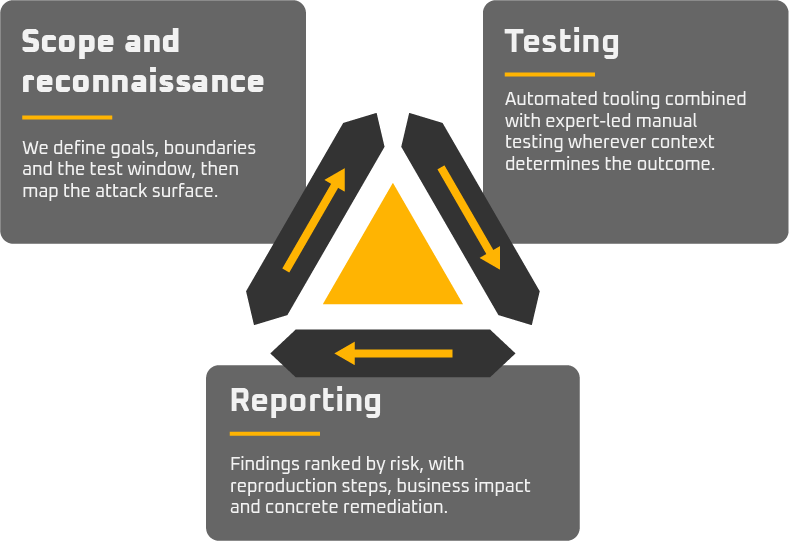
The questions we hear most often before a contract is signed.
The cloud pentest is the offensive read at a point in time. Security engineering is what closes what it finds — and keeps it closed as the environment changes. Both are useful; they are complementary, not alternatives.
Azure primarily, with AWS and GCP support. Our team runs production Azure at scale every day, so we have depth there; the architecture and principles translate across providers.
No. We work with the tools you already use — Terraform, Bicep, Ansible, ARM. Policy enforcement plugs into your existing delivery pipeline rather than requiring a new one.
Contact us
For any matter, you can reach us using the contact details below or via the contact form.

If you would like to speak with us in person, we invite you to book a meeting using the Microsoft Bookings platform.
Book a meeting in Microsoft Bookings