

Security services
Security from the team that builds the cloud it secures
Offensive assessment and defensive engineering across web, mobile, cloud, network, containers and AI. Point-in-time or continuous — the same standard either way, and a report your engineers can act on and your board can read.

Attackers don't wait for your schedule. Regulators and contractors don't either.
Automated adversaries
Threat to every machine

Most attacks are automated. Exposed surfaces are enumerated continuously, regardless of company size.
Regulatory obligation
High penalties for lack of due diligence

NIS2 is in force in Poland since 3 April 2026, with registration due by 3 October 2026 and liability on management personally.
Buyer requirements
Contracts only for certified partners

Enterprise counterparties increasingly require evidence of security before they contract. A current report is the condition of entry.
Offensive assessment that finds the paths. Defensive engineering that closes them for good.


Every engagement is structured around recognised industry frameworks — not proprietary methods.

List of the ten most important security threats to web applications, published by the OWASP community.
Learn more →Catalog of key vulnerabilities specific to REST API and GraphQL interfaces, developed by OWASP.
Learn more →A standard of security requirements for mobile applications on Android and iOS platforms.
Learn more →A compilation of ten main threats for applications based on large language models (AI/LLM).
Learn more →
A standardized methodology for conducting penetration tests covering the full cycle of security assessment.
Learn more →
Repository of information about the tactics, techniques and procedures used by real cybercriminals.
Learn more →
The NIST technical guide regarding planning and conducting security assessments of information systems.
Learn more →
Proven security configurations for operating systems, cloud environments and network devices.
Learn more →
A framework aimed at ensuring software supply chain integrity — from source code to artifacts.
Learn more →NIST guidelines for the security of application containers and containerization environments.
Learn more →An operator's perspective — not an external auditor's — changes what we see in a client's environment.
We build it
Proprietary cloud environments

We design and operate production cloud environments every day — hardened networking, scoped identity, monitoring.
We break it
Attacker mindset

Adversarial testing across the full attack surface, chaining findings into the paths that actually reach your data.
We defend it
Minimizing attack vectors

Continuous DevSecOps and detection that closes the gaps for good, in the systems you operate.
A defined-scope project or continuous penetration testing — depends on the pace of your releases.
- Scope agreed in a conversation, not an RFP form
- Attack narrative written by the testers — not a scanner export
- One retest included — we verify the finding is actually closed
- For an audit, contractor, compliance requirement or board
- Results available live during the test — not a week after it ends
- Test cycle matched to your release cadence
- Unlimited retests — no separate invoice
- Direct contact with the tester who knows your environment — not a helpdesk
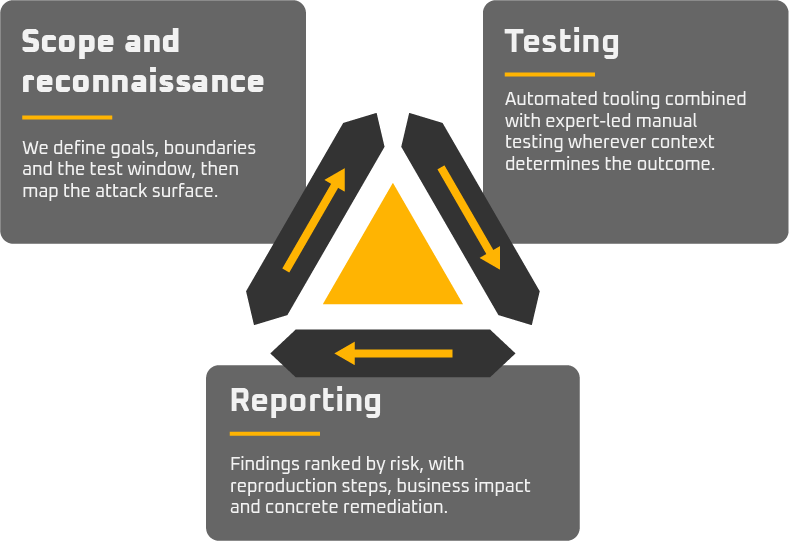
A structured process from first conversation through testing to verification of closed vulnerabilities.
Contact us
For any matter, you can reach us using the contact details below or via the contact form.

If you would like to speak with us in person, we invite you to book a meeting using the Microsoft Bookings platform.
Book a meeting in Microsoft Bookings