

Mobile application penetration testing
We test Android and iOS apps on rooted and jailbroken devices with live instrumentation: what an adversary extracts from the binary, what the app trusts on the wire, and what the backend exposes once its client-side controls are removed.
The full attack surface — not just what's visible from the outside.
Local data & secrets
Secrets stored on the device

Keychain/Keystore use, plaintext in shared preferences and SQLite, cached credentials, logs and backups, and keys recoverable from the binary.
Transport security
A network you don't control

TLS configuration, certificate pinning and its bypass under instrumentation (Frida/objection), and MITM resilience on hostile networks.
Runtime & anti-tampering
Threats in the runtime environment

Root and jailbreak detection, anti-debug and anti-hooking defenses, code integrity, and how fast they fall to instrumentation.
Platform IPC & deep links
Ways to bypass the interface

Exported components, intent and URL-scheme handling, and WebView and JS-bridge exposure.
Authentication & session
Does the server enforce when the client lies

Token storage and lifetime, biometric gating, and whether server-side controls survive a tampered client.
Established industry frameworks — not proprietary checklists.
Verification standard and test methodology, executed manually on instrumented devices.
Frida/objection-driven analysis: pinning bypass, hooking and live tampering.
Applied to the backend, where client-side controls stop protecting you.
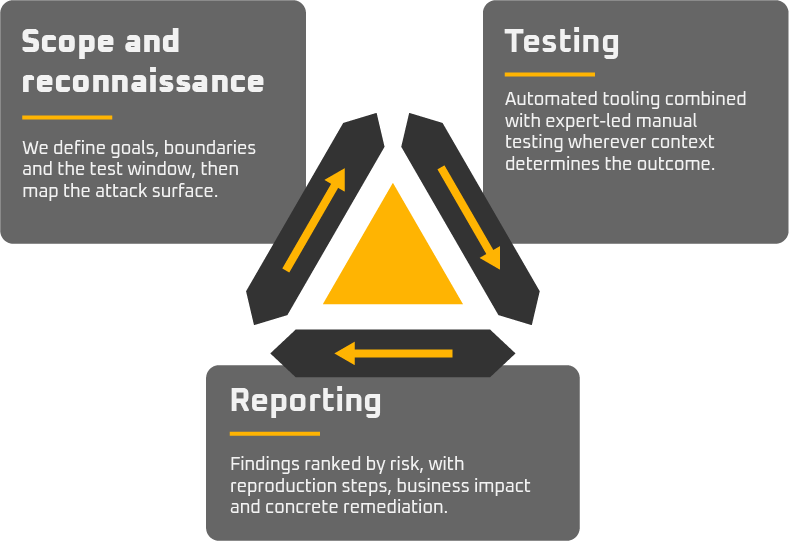
A structured process from scope to retest — no surprises at delivery.
The questions we hear most often before a contract is signed.
A signed build is enough for black-box. Source, test accounts and architecture context move us to grey-box and raise coverage per day. Either way we instrument on our own rooted/jailbroken devices.
They deter casual analysis but don't survive a determined tester. We bypass them as a matter of course; the engagement measures what your backend enforces afterward.
Yes, tested separately. Storage, IPC and platform controls differ enough that findings rarely carry over.
Contact us
For any matter, you can reach us using the contact details below or via the contact form.

If you would like to speak with us in person, we invite you to book a meeting using the Microsoft Bookings platform.
Book a meeting in Microsoft Bookings