

Web application and API penetration testing
We assess web applications and their APIs the way a motivated adversary does: chaining lower-severity findings into a working path to your data, rather than handing you a scanner export. The deliverable is an exploitation narrative your engineers can act on and your board can read.
The full attack surface — not just what's visible from the outside.
Authorization & access control
Most common root cause of breaches

Horizontal and vertical privilege escalation, IDOR, broken multi-tenant isolation, and implicit trust between internal services.
Authentication & session management
An unvalidated token is an open door

Credential and token handling, MFA bypass, session fixation, and OAuth/OIDC and SSO misuse.
Injection & server-side flaws
Highest-severity vulnerability class

SQLi, SSRF, template and deserialization injection, and file-upload and parsing abuse.
API security
Defence in depth

Object- and function-level authorization, mass assignment, excessive data exposure and broken rate limiting (OWASP API Top 10).
Business logic
No scanner catches this

Workflow, pricing and entitlement abuse that is technically valid but illegitimate in intent — the class of vulnerability no scanner can find.
Exploit chaining
The synergy of small flaws

Combining individually low-rated findings into a single high-impact attack path.
Established industry frameworks — not proprietary checklists.
Applied as a manual verification baseline, not a checklist run by a tool.
The risk model for the API tier, where most modern applications actually break.
Structured test cases that keep coverage repeatable and defensible under audit.
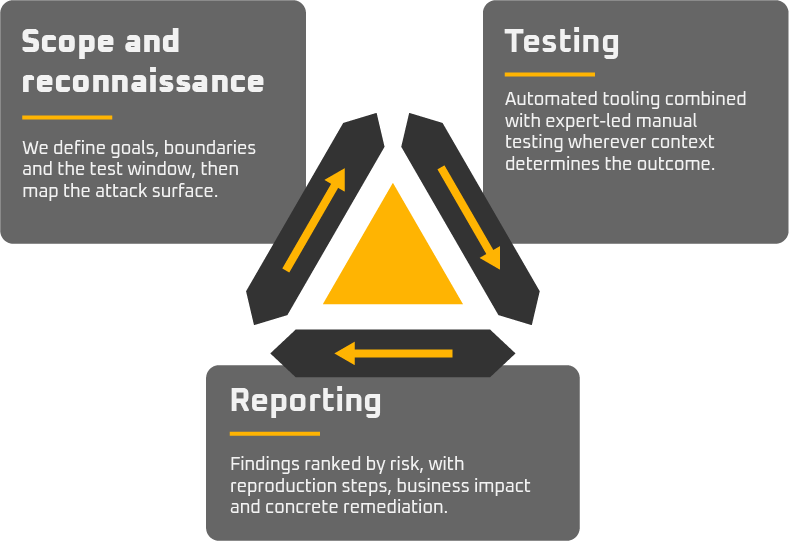
A structured process from scope to retest — no surprises at delivery.
The questions we hear most often before a contract is signed.
An exploitation narrative: every finding with root cause, reproduction, demonstrated impact and remediation mapped to your stack, followed by a retest. Not a raw scanner export.
Grey-box is the default for most applications: authenticated access and architectural context yield materially higher coverage per day than blind black-box. We run black-box where the objective is specifically to assess the unauthenticated perimeter.
A scoped window, rate-controlled testing, a named contact on your side and an agreed rollback path. Destructive test cases run against staging or under explicit written sign-off.
Contact us
For any matter, you can reach us using the contact details below or via the contact form.

If you would like to speak with us in person, we invite you to book a meeting using the Microsoft Bookings platform.
Book a meeting in Microsoft Bookings